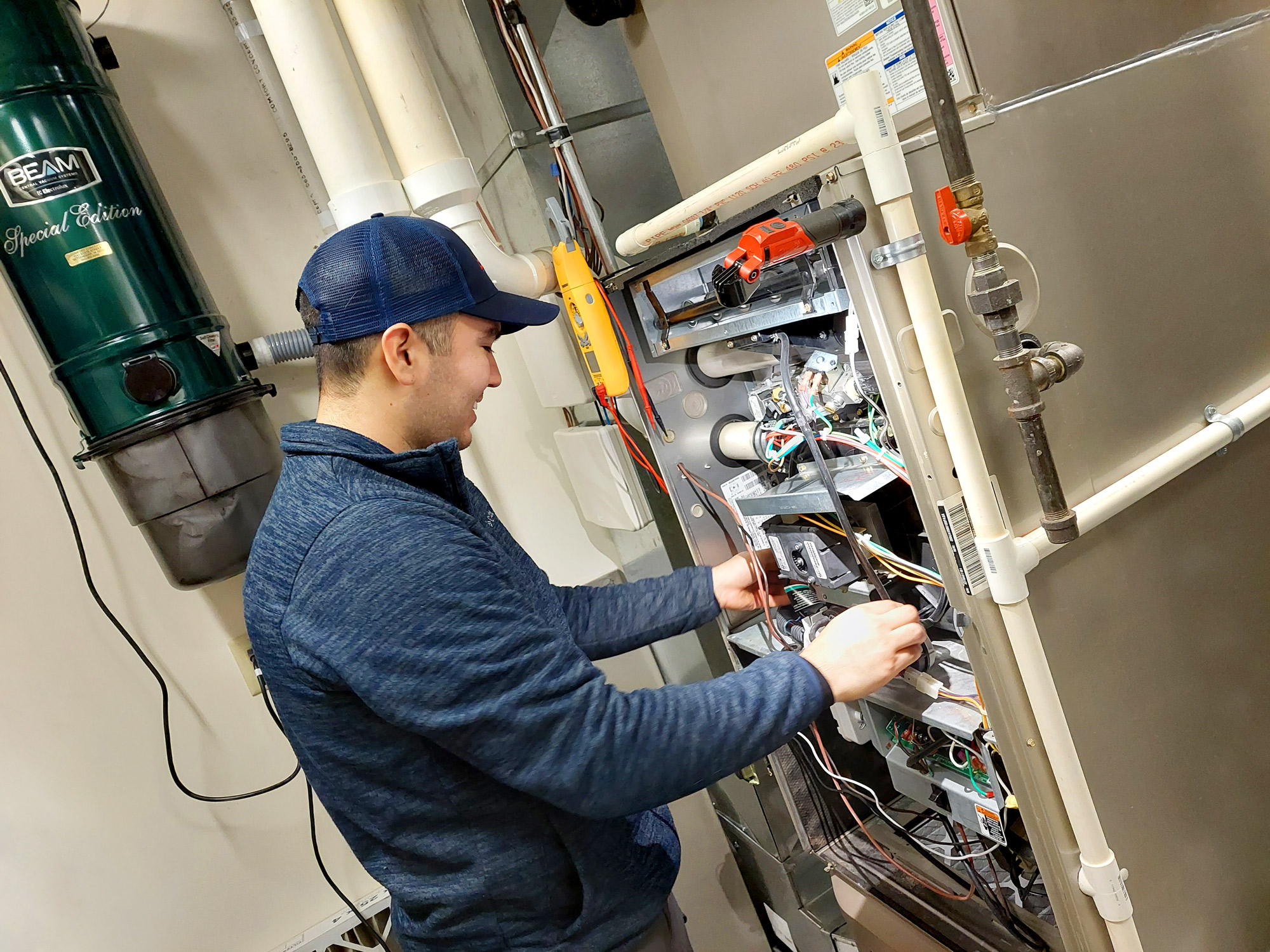
A furnace near the end of its life usually gives a few winters of warning: more repairs, higher gas bills, rooms that never warm up. This guide covers furnace replacement cost in the Quad Cities, the signs yours is dying, whether an old furnace can explode, and when one more repair still makes sense.
How Much Does a New Furnace Cost in the Quad Cities?
Furnace replacement cost usually runs about $2,800 to $6,900 for a gas furnace, installed, with national averages near $4,800. A high-efficiency furnace that needs new venting, duct changes or gas and electrical work can reach $10,000 to $12,000. Those are national figures, not Doug’s prices, and the range is wide because the furnace is only part of the job. Doug’s Heating & Air Conditioning prices a replacement after we’ve looked at the furnace, the venting, the ductwork and the air conditioner coil that sits on top of it, so the quote covers the whole install. What moves the price:
| What changes the price | Lower end | Higher end |
|---|---|---|
| Efficiency | 80% AFUE, single-stage | 95% AFUE or higher, two-stage or variable-speed |
| Venting | Reuses the existing metal flue | New PVC vent through the wall, plus a condensate drain |
| Ductwork and access | Existing ducts fit, open basement | Duct changes, or a tight closet, attic or crawlspace |
| Scope | Furnace only | Furnace and air conditioner together |
Older Quad Cities homes can add one item. When a 95% furnace replaces one that shared a chimney with the water heater, the water heater is left venting alone through a chimney sized for two, and it may need a liner. We check for that during the estimate.
How Can You Lower the Cost of a New Furnace?
Doug’s currently takes $500 off a new energy-efficient furnace when we buy back your old one, and new furnace installs start at $75 a month with approved financing. The buyback can’t be combined with other Doug’s offers, so we’ll show you which saves more. Our current specials list what’s running this month. We also offer financing through Synchrony, and homeowners who’ve been turned down for traditional financing can look at the Atwood Rentals rent-to-own program.
MidAmerican Energy customers can also get an instant discount on a qualifying natural gas furnace, figured at $2.40 per thousand BTUs of input in 2026. That’s about $192 on an 80,000 BTU furnace. It only comes through participating contractors and can’t be combined with other MidAmerican rebates, so ask before you buy (our MidAmerican rebate guide has the details). There’s no federal tax credit for a furnace installed in 2026, because the 25C credit ended for equipment placed in service after December 31, 2025.
How Can I Tell If My Furnace Is Dying?
A furnace is usually dying when it’s past 15 years old and starts needing repairs more often, costing more to run, or heating the house unevenly. One of those on its own is a service call. Two or three together on an older furnace mean it’s time to price a replacement before it quits on the coldest night of the year. Watch for these signs:
- It’s past 15 years old. Many run longer, but 15 years is when to start planning.
- It needs repairs every winter. Two significant repairs in two winters is a pattern, not bad luck.
- Your gas usage is climbing. A gas furnace losing efficiency shows up on the gas bill, not the electric bill. Compare winter therms year to year rather than dollars, since rates change.
- Some rooms never warm up, or it short-cycles (starts and stops every few minutes).
- It’s making new noises. Banging, squealing or rattling from the burners or blower.
- The burner flame is yellow or flickering. It should be mostly blue.
- There’s rust, soot or water around the furnace or flue pipe. That points to a venting problem, which can mean carbon monoxide.
- A technician found a cracked heat exchanger. That’s a safety problem, not a comfort one, and on an older furnace it usually ends in a replacement.
Can an Old Furnace Explode?
A furnace explosion is very rare. Modern gas furnaces have several safety controls that shut off the gas if the burners don’t light, the flame isn’t detected or the venting is blocked. The bigger danger from an old furnace is carbon monoxide leaking from a cracked heat exchanger or a failing vent, which you can’t see or smell, so every home with a gas furnace needs working carbon monoxide alarms near the bedrooms. A loud bang when the burners light is still worth a service call. It usually means delayed ignition: gas builds up for a moment before it lights, often from dirty burners or a weak igniter, and it strains the heat exchanger every time.
If you smell gas, leave the house first, then call MidAmerican Energy at 800-595-5325 or 911 from outside. MidAmerican supplies gas on both sides of the river, so it’s the same number in Illinois and Iowa. If your carbon monoxide alarm sounds, get everyone outside and call 911.
How Long Does a Furnace Last in the Quad Cities?
A well-maintained gas furnace usually lasts 15 years or more, and many reach 20 or beyond with a tune-up every fall. A Quad Cities furnace works harder than one in a mild climate. Our winter design temperature is -2°F, the cold a heating system here is sized to hold against, and a long January puts more run hours on the blower, igniter and heat exchanger every year. Annual maintenance decides which end of that range you land on, because a technician who cleans the burners and checks the heat exchanger each fall catches small failures before they turn into big ones.
Should You Repair or Replace an Old Furnace?
Replace a furnace when it’s past about 15 years old and facing a major repair, when it needs a second big repair in a few winters, or when it has a cracked heat exchanger. A quick check is the $5,000 rule: multiply the furnace’s age by the repair cost, and a result over $5,000 points to replacement. A 20-year-old furnace with a $400 repair comes to $8,000. An 8-year-old furnace with a $300 igniter comes to $2,400, an easy repair. Our furnace repair cost guide lists common repair prices so you can run the math. When it’s close, our technician will give you both prices and let you decide.
One customer described that decision in a January review: “Instead of charging us outrageous prices to fix our 21 year old furnace we decided to buy a brand new one from them and they installed it 2 days later.”
What Size and Efficiency Furnace Do You Need?
The right furnace is sized to your home’s heat loss, not copied from the old furnace’s label. Doug’s Heating & Air Conditioning sizes a furnace replacement to hold your home against the -2°F design temperature for Rock Island and Scott counties, using its insulation, windows and square footage. Plenty of older furnaces here are oversized, so they short-cycle, heat unevenly and wear out sooner. For efficiency, AFUE is the share of the gas a furnace turns into heat for your home. Many older furnaces are 78% to 80%. A condensing furnace is 95% or higher, and the YORK® Affinity furnaces we install reach up to 98%. Going from 80% to 96% cuts the gas you burn for the same heat by about a sixth, which adds up over a Quad Cities winter.
Frequently Asked Questions
How long does it take to replace a furnace?
A straight furnace swap in a basement is usually a one-day job. New venting, duct changes or a new air conditioner at the same time can add a second day.
Should I replace my air conditioner at the same time as my furnace?
If your air conditioner is more than 10 years old, price both. The AC’s indoor coil sits on the furnace and shares its blower, so replacing them together means one install and matched equipment. If the AC is newer, replacing only the furnace is fine.
Is a 95% furnace worth it in the Quad Cities?
Usually, yes. Long heating seasons give a high-efficiency furnace more hours to pay back its higher price, and MidAmerican’s instant discount only applies to qualifying furnaces. An 80% furnace can still make sense when venting a condensing furnace would be difficult or you plan to sell the house soon.
Get a Furnace Replacement Estimate From Doug’s
Doug’s Heating & Air Conditioning has served Moline, Davenport, Rock Island, Bettendorf and the rest of the Quad Cities since 1962. Call us in Illinois at 309-764-2500 or in Iowa at 563-326-1223, or request an estimate online. If your furnace has already quit, we answer 24/7.