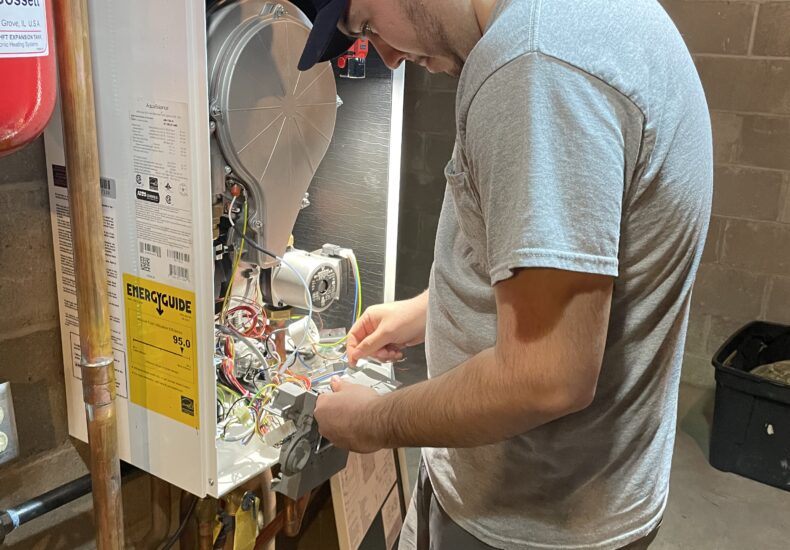
An old boiler that needs work this winter leaves you with one question: fix it again or replace it. This guide covers boiler replacement cost in the Quad Cities, the repairs that are usually worth making, the signs a boiler is done, and what changes when your home has steam radiators.
How Much Does It Cost to Replace a Boiler in the Quad Cities?
Boiler replacement cost usually runs about $4,000 to $9,000 for a standard-efficiency gas boiler, installed, and about $6,000 to $11,000 for a high-efficiency condensing boiler. National averages sit near $5,900. Those are national figures, not Doug’s prices, and older Quad Cities homes often land near the top because the piping, the chimney and the insulation on old pipes all show up on the quote. Doug’s Heating & Air Conditioning prices a boiler replacement after we’ve seen the boiler, the near-boiler piping, the venting and the radiators, so the number covers the whole install. Common add-ons:
| Item | Typical cost | When it applies |
|---|---|---|
| Chimney liner | $1,500 to $4,000 | A new boiler venting into an old, unlined masonry chimney |
| Indirect water heater | $1,200 to $4,000 | When the boiler will also make your household hot water |
| Asbestos removal (small area) | $1,150 to $3,000 | Old pipe or boiler insulation that tests positive |
| Typical boiler repair | $200 to $600 | Most pumps, valves, igniters and controls; some run near $1,700 |
There’s no MidAmerican Energy instant discount on a boiler right now (the program covers furnaces, heat pumps, air conditioners and heat pump water heaters), and no federal tax credit for a boiler installed in 2026, because the 25C credit ended for equipment placed in service after December 31, 2025. You can spread the cost with financing through Synchrony.
Which Boiler Problems Are Usually Worth Repairing?
Most boiler problems are repairs, even on an old boiler. A cast-iron boiler body can outlast several sets of pumps, valves and controls, so a failed part usually doesn’t mean the boiler is finished. The repairs below typically fall in the $200 to $600 range and can buy many more winters on a boiler that’s otherwise sound. Common ones:
- Cold radiators, or radiators that are cool at the top. Usually air in the system. Bleeding the radiators often fixes it.
- A dripping pressure relief valve. Often a waterlogged expansion tank or a failing fill valve, not the boiler.
- No heat with the boiler running. Frequently a circulator pump, zone valve or thermostat.
- The boiler won’t light. An igniter, thermocouple, flame sensor or gas valve, all replaceable.
- Banging or rumbling. Often sludge or scale inside the boiler, which a flush or cleaning can help.
One customer described a second opinion that went the other way: “Had another company check my boiler, was told I needed a new boiler. Got second opinion from Doug’s… 2 hrs later boiler cleaned, heat back on.” (David Z., Google review, January 2025)
When Should You Replace an Old Boiler?
Replace a boiler when the boiler itself is failing, not just a part on it. The clearest sign is a leak from the boiler body: water at the base, between cast-iron sections or from the heat exchanger. A cracked section can’t be patched reliably, and on most older boilers it ends in replacement. Other strong signs are a boiler past 15 years old that needs a major repair every winter, rising gas use for the same comfort, and parts that are no longer made. Two or three together on an older boiler usually mean it’s time to plan a replacement before it quits in January. Watch for:
- Water leaking from the boiler body, or you’re adding water to the system often.
- Repairs every heating season on a boiler past about 15 years old.
- Rust-colored water or heavy corrosion on the boiler or its flue connection.
- Soot, scorch marks or an exhaust smell near the boiler. That points to a combustion or venting problem, which can mean carbon monoxide. Have it checked right away, and if a carbon monoxide alarm sounds, get everyone outside and call 911.
How Long Does a Boiler Last?
Most boilers last about 15 to 20 years, and cast-iron boilers often last well past 20 with yearly service. That’s longer than a typical furnace, so age alone says less about a boiler than it does about a furnace. The age-times-repair-cost “$5,000 rule” from our furnace replacement cost guide is a rough fit here: it would flag almost any repair on a 30-year-old cast-iron boiler, even one with a sound body and years left. For a boiler, the better questions are whether the body is leaking, whether parts are still available and how efficiently it runs. Newer high-efficiency boilers use lighter heat exchangers that need regular cleaning to reach their full life, so a yearly boiler tune-up matters even more on a new boiler.
Does a Steam Boiler Change the Decision?
Yes. A steam boiler is replaced with another steam boiler sized to the radiators in your house, not to the home’s heat loss, and it can’t be a condensing boiler. That’s different from a hot-water system, where the boiler is sized to the home’s heat loss and a high-efficiency condensing model is often an option. Some older Quad Cities homes still heat with steam, and a wrong-sized replacement can leave cold radiators or short-cycle, banging pipes. A good steam estimate starts with measuring the radiators, not reading the old boiler’s label. The near-boiler piping also matters more on steam, because it decides whether the boiler sends dry steam to the radiators or pushes water up the pipes. If you’re not sure which you have, a gauge in pounds and a glass sight tube on the side of the boiler usually mean steam.
Is a High-Efficiency Boiler Worth It in an Older Home?
Often, yes, if your home has a hot-water system. A condensing boiler is 90% to 95% efficient or more, compared with the mid-80s for a new standard boiler and less for many old ones. It saves the most when it runs cooler water, and many older homes can do that. Their radiators were sized before new windows and insulation, so they can heat the house with cooler water through most of the winter. A condensing boiler vents through PVC instead of the chimney and needs a condensate drain, which adds to the install. A standard boiler can still make sense when the chimney is in good shape and you’d rather keep the upfront cost down. Doug’s installs Weil-McLain® boilers, and when it’s close we’ll price a standard and a high-efficiency option side by side.
Frequently Asked Questions
How long does a boiler replacement take?
Doug’s Heating & Air Conditioning usually plans a residential boiler replacement as a two- to three-day job, longer when piping, venting or an indirect water heater changes. That’s longer than a typical furnace swap, so it’s worth scheduling before the boiler fails.
Should I switch from a boiler to a furnace?
Usually not. A furnace needs ductwork, and adding ducts to a home built for radiators means opening walls and ceilings. Most boiler homes are better served by a new boiler. If the house already has ducts for central air, it’s worth pricing both.
Can you add central air to a house with a boiler?
Yes. Many older Quad Cities homes keep the boiler for heat and add ductless mini-splits or a high-velocity system for cooling, which avoids running full-size ducts through plaster walls.
Get a Boiler Repair or Replacement Estimate From Doug’s
Doug’s Heating & Air Conditioning has worked on Quad Cities boilers since 1962, from old steam systems to new condensing boilers. If you want a second opinion on a replacement quote or your boiler needs heating repair, call us in Illinois at 309-764-2500 or in Iowa at 563-326-1223, or request service online. We answer 24/7.
Related posts
 Generators
What Does a Whole-House Generator Cost in the Quad Cities?
 Heating